
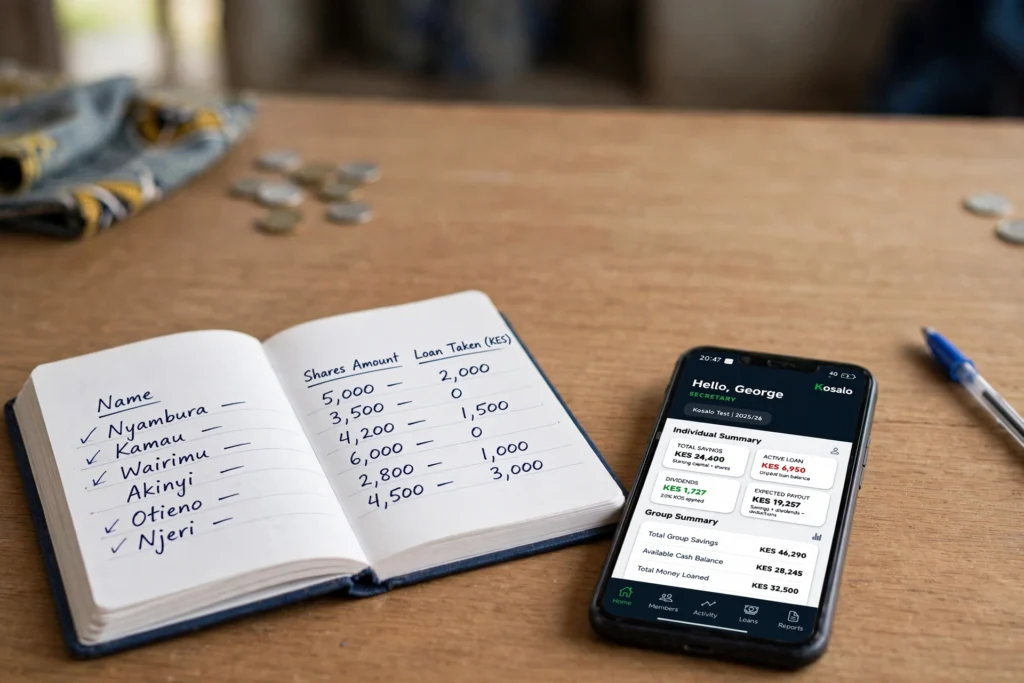
Every chama runs on trust. Members hand over their money believing someone, usually the secretary, is keeping an accurate record of who paid what, who borrowed what, and what everyone’s owed at the end.
But most chamas still track all of this the same way they did twenty years ago: a notebook, a pen, and one person trying to remember everything. It works fine, until the day it doesn’t. One missed entry or one wrong figure, and months of goodwill can unravel fast.
Here are five mistakes we see over and over in chama record keeping, and what they usually end up costing groups.
1. Everything lives in one notebook
Walk into almost any chama meeting and you’ll find the same thing sitting at the center of the table: one notebook, holding the entire financial history of the group. It’s usually a bit worn at the edges, maybe held together with a rubber band, and everyone treats it with a certain amount of respect because they know what it represents.
The problem is that this single book carries all the risk along with all the history. If it gets left in the rain, chewed by something, or simply misplaced on the way to a meeting, there is no second copy to fall back on. Some secretaries try to solve this by keeping a duplicate notebook at home, updating both after every meeting, but that just means double the writing and double the chance the two versions quietly drift apart.
And when that happens, nobody can say for certain which one is correct. A single physical book was never designed to be a safe, permanent record, it was just the easiest tool available at the time.
What it costs: disputes nobody can settle, because there’s no reliable record to point to.
2. Dividends calculated by hand
At the end of a savings cycle, someone has to sit down and work out exactly how much each member takes home, based on months of contributions, any loans they took, and the interest owed on those loans.
For a group of twenty, thirty, or fifty members, that’s not a quick sum, it’s hours of cross checking numbers scattered across many pages.
Most secretaries do this by hand, often late at night before the big payout meeting, working purely off the notebook and a calculator. It is exactly the kind of repetitive, detail heavy task where a single transposed digit or a missed row can throw off the whole calculation.
And because the process is manual, there’s often no easy way to double check the final numbers without redoing the entire thing from scratch. The pressure is real too, because members are waiting on these figures, and a mistake here isn’t just a math error, it’s someone’s money.

What it costs: one member gets shortchanged by a small mistake, and suddenly the whole group’s trust takes a hit, even if it was totally unintentional.
3. Writing things up days later
In theory, every contribution should be written into the ledger the moment it’s collected. In practice, meetings move fast, cash and M-Pesa confirmations come in from different directions, and the actual recording often gets pushed to later that evening or even a few days after.
By the time the secretary sits down to update the book, she’s working from memory, a stack of mobile money messages, and whatever notes she scribbled during the meeting itself.
The longer that gap between collecting the money and writing it down, the more room there is for something to slip through unnoticed. A contribution might get logged under the wrong name, entered twice, or missed entirely if a message gets buried in a busy phone.
None of this happens out of carelessness, it’s simply what happens when record keeping depends on catching up later rather than capturing things in real time.
What it costs: contributions that quietly slip through the cracks, and arguments about it at the next meeting.
4. No clear picture of who’s repaid their loan
Loans are often where a chama’s finances get genuinely complicated. At any given time, there might be several members with active loans, each on a different repayment schedule, each accruing interest at a slightly different pace depending on when the loan was issued.
Keeping track of all of that by hand means flipping back through pages to find when a loan started, what’s already been paid, and what interest has accumulated since. It is easy, and completely understandable, for a repayment to get logged late, misattributed to the wrong loan, or missed altogether when things get busy.
Over time, small gaps like this add up, and the group can end up with a loan book that looks fine on paper but doesn’t actually reflect who owes what. That mismatch usually doesn’t surface until someone goes looking for it, often right when the fund needs those repayments the most.
What it costs: unpaid loans nobody notices until the fund comes up short at payout time.
5. One person carries it all in their head
Ask most chamas who really understands the state of their records, and the answer is almost always the same person, the secretary. She’s not just writing entries, she’s holding the context behind them, why a certain figure looks the way it does, which member had an arrangement to pay late, which entry was corrected and why.
None of that lives in the notebook itself, it lives in her memory. That works fine as long as she’s present and available, but the moment she’s sick, traveling, or steps down from the role, the group is left trying to reconstruct months of decisions and context from a book that only tells half the story.
Handing the role over to someone new becomes a slow, uncertain process, because so much knowledge was never written down in the first place. A record system that depends entirely on one person’s memory is only ever as reliable as that person’s availability.
What it costs: the group’s entire financial history depends on one person being around.
The notebook doesn’t have to go
None of this means ditch the ledger. Chamas have run on notebooks for generations, and there’s real value in having a physical record everyone can see and trust. The problem isn’t the notebook itself, it’s that a notebook alone has no backup, does no math for you, and can’t catch a mistake before it becomes an argument.
That’s the gap something like Kosalo fills, not replacing your ledger, but working next to it. It tracks contributions as they come in, calculates dividends automatically, and keeps loan balances up to date, so nothing depends on one person remembering everything.
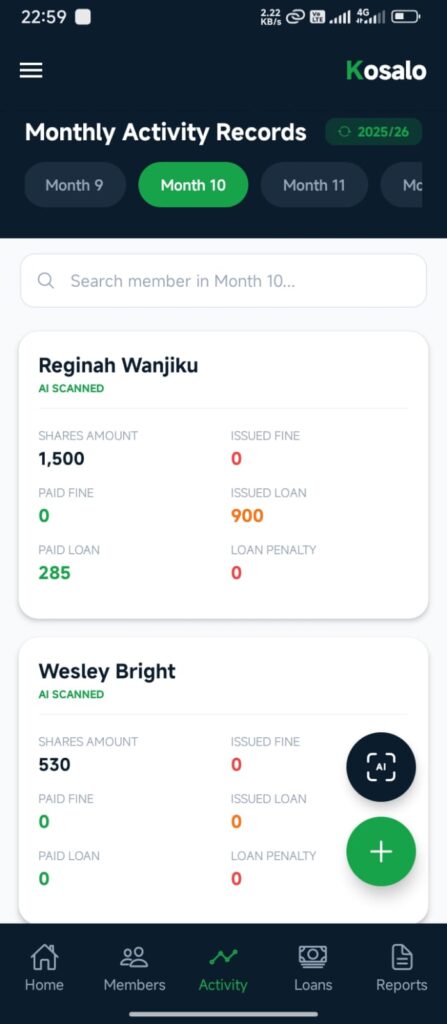
If any of this sounds familiar, it might be worth running a digital record alongside your notebook for one cycle, just to see how it feels.